
Was It Fair Use? Kool G Rap & DJ Polo – “Road To The Riches” (prod. by Marley Marl)
Applying the thresholds of the fair use test to one of hip hop/rap music's greatest sample-based songs.
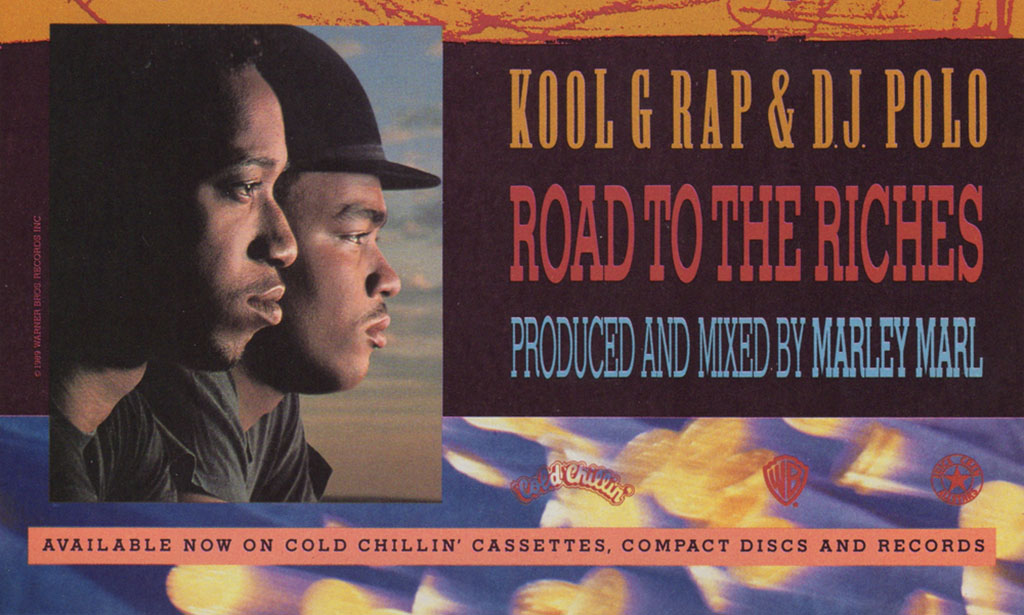
Released in 1989 as the title track off the album of the same name, “Road To The Riches,” produced by Marley Marl, features a sample of Billy Joel’s “Stiletto” (1979). Kool G Rap & DJ Polo and Marley Marl were never sued for copyright infringement, and for good reason. “Roads To The Riches” would likely have been proven to be fair use in court.
Kool G Rap & DJ Polo – “Roads to Riches” prod. by Marly Marl
Billy Joel – “Stiletto”
Fair Use Defined: Analysis of the Four Factors of Fair Use
The fair use statute in the Copyright Act of 1976 lists four pertinent factors to be considered when determining whether a secondary use is fair use, i.e. permissible and not legally actionable. These factors are not to be a tally of the majority; it’s not as simple as three out of four of the factors automatically means fair use. Likewise, one out of three factors doesn’t automatically mean that a secondary use wasn’t fair use. (If just one factor is satisfied — particularly the first factor, the factor dealing with transformation — a secondary use may still be considered fair use.) Instead, the statutory factors serve as a guide that directs courts to examine the issue (material facts) from every relative angle. “Each factor directs attention to a different facet of the problem. The factors do not represent a score card that promises victory to the winner of the majority. Rather, they direct courts to examine the issue from every pertinent corner and to ask in each case whether, and how powerfully, a finding of fair use would serve or dis-serve the objectives of copyright.”162
The First Factor: “The purpose and character of the use, including whether such use is of a commercial nature or is for nonprofit educational purposes”
The first factor, or as it is commonly referred to as “factor one,” is said to be the “soul of fair use” or the heart of the fair use test because this factor “raises the question justification. Does the use fulfill the objective of copyright law to stimulate creativity for public illumination? This question is vitally important to the fair use inquiry, and lies at the heart of the fair user’s case.”[1] The first factor considers whether and to what extent the use is transformative. If quoted matter — i.e. the subject matter copied, for example, a literary work or sound recording — is used as raw material, transformed in the creation of new information, new aesthetics, new insights, and new understandings, then it is more likely to pass the fair use test. On the other hand, minimal transformation will not likely pass the test.
Moreover, the first factor “calls for careful evaluation whether the particular quotation is of the transformative type that advances knowledge and the progress of the arts or whether it merely repackages, free riding on another’s creations. If a quotation of a copyrighted matter reveals no transformative purpose, fair use should perhaps be rejected without further inquiry into the other factors.” Transformative uses may include: “criticizing the quoted work, exposing the character of the original author, proving a fact, or summarizing an idea argued in the original in order to defend or rebut it. They also may include parody, symbolism, aesthetic declarations, and innumerable other uses….”[2]
Judge Leval has stated that the use “must be productive and must employ the quoted matter in a different manner or for a different purpose from the original.”[3] But this is wrong and misleading. First, it’s not always clear how “productive” is to be defined and who is supposed to define it. In this regard, some uses may appear to be more productive; take for example a protest song that makes use of a vocal sample. Second, the use does not have to employ the quoted matter in a different manner or for a different purpose from the original; a use can be employed in the same manner as the original and still have a different purpose.
The first factor also raises the question of whether the use is of a commercial nature or for nonprofit educational purposes. While it has been widely held that nonprofit educational purposes tip the scale in the direction of a fair use, a use made for commercial purposes may also be a fair use. In other words, a use made for commercial purposes is not automatically excluded from being fair use; conversely, a use that is of a nonprofit educational purpose is not automatically fair use.
The Transformative Element of the First Factor
The Meta Sub-Factor
Officially, there are no “sub-factors” to the four-factor fair use inquiry, but if there were, the transformative element of factor one is the most powerful sub-factor of them all. If factor one is the heart of the fair use test, then the transformative element is its main artery. In observing the objectives of copyright and how transformative uses of copyrighted works fulfill those objectives, the Supreme Court has stated that “the goal of copyright, to promote science and the arts, is generally furthered by the creation of transformative works. Such works thus lie at the heart of the fair use doctrine’s guarantee of breathing space within the confines of copyright.”[4] The transformative element of factor one is so dominant that it not only renders the commerciality element irrelevant, it also essentially eclipses the other three factors, even the fourth factor which many commentators wrongly interpret as being the determining factor in the fair use test. Again, here, Beebe’s study supports this:
…a finding of transformativeness trumped a finding that the defendant’s use was commercial for purposes of determining whether factor one favored fair use. In 28 opinions, the court found the defendant’s use to be both commercial and transformative under factor one, and in 26 of these opinions, the court found both that factor one and the overall test favored fair use with one of the two outliers reversed on appeal. [emphasis mine][5]
Hence, despite conventional wisdom to the contrary, factor one has significant influence over the overall outcome of the fair use test. And since Campbell (1994), the transformative element has become the most important sub-factor in a court’s overall fair use determination. Nonetheless, even non-transformative use can still qualify as fair use. The point is, however, the more transformative the use, the more likely the courts will determine the use to be fair use:
The more transformative the new work, the less will be the significance of other factors, like commercialism, that may weigh against a finding of fair use. [emphasis mine][6]
The Second Factor: “The nature of the copyrighted work”
The second factor looks at the type of material that copyright was designed to stimulate, i.e. whether the copyrighted work is fictional or non-fictional (facts). Creative works receive more protection than factual ones; think of a novel vs. a telephone book. In principle, the more creative a copyrighted work is, the more the other factors must favor the secondary user in order to earn a fair use finding. The second factor also looks at whether a work was published or unpublished. And “[t]he fact that a work is unpublished shall not itself bar a finding of fair use if such finding is made upon consideration of all” four factors.[7] Finally, while the implication may be that certain types of copyrighted material are more amenable to fair use than others, the scope of fair use is not narrowed by the nature of a copyrighted work.
In the overall fair use analysis, the second factor is fairly insignificant. In practice, the second factor has minimal impact:
Fair use opinions continue routinely to denigrate factor two as unimportant to the overall fair use analysis and the updated data support the view that the factor typically has a relatively minimal impact on the outcome of the overall four-factor test. [emphasis mine][8]
The Third Factor: “The amount and substantiality of the portion used in relation to the copyrighted work as a whole”
The third factor considers the amount of the copyrighted work that has been used in the new work. Generally, a small amount tips the scale towards fair use. In Ringgold v. Black Entertainment Television, Inc. (1997), the 2nd Circuit maintained that “the third fair use factor concerns a quantitative continuum. Like all the fair use factors, it has no precise threshold below which the factor is accorded decisive significance. If the amount copied is very slight in relation to the work as a whole, the third factor might strongly favor the alleged infringer.”[9] Judge Leval offers additional clarification:
The third statutory factor instructs us to assess ‘the amount and substantiality of the portion used in relation to the copyrighted work as a whole.’ In general, the larger the volume (or the greater the importance) of what is taken, the greater the affront to the interests of the copyright owner, and the less likely that a taking will qualify as fair use.
This factor has further significance in its bearing on two other factors. It plays a role in consideration of justification under the first factor (the purpose and character of the secondary use); and it can assist in the assessment of the likely impact on the market for the copyrighted work under the fourth factor (the effect on the market). As to the first factor, an important inquiry is whether the selection and quantity of the material taken are reasonable in relation to the purported justification…. The more taken the greater the likely impact on the copyright holder’s market, and the more the factor favors the copyright holder. Too mechanical a rule, however, can be dangerously misleading. One can imagine secondary works that quote 100% of the copyrighted work without affecting market potential. [emphasis mine][10]
But even a small amount may not meet the fair use threshold if it can be considered the heart of the copyrighted work. Conversely, since there is “no precise threshold,” even the copying of an entire work may still qualify as fair use. It depends on the context and purpose of the copying and any number of different elements.
Next, the third factor considers how substantial is the portion of the copyrighted work that has been used. Here, “substantiality” relates to the significance of the portion copied in relation to the work as a whole. Often at question is whether or not the “heart” of work was copied. An example of the heart of a work could be the hook in song or its main melody. Eight bars of the main melody of a song are more likely to be considered substantial; however, a single kick drum is not likely to be considered substantial. In principle, the more insubstantial the copying is, i.e. the less used in relation to the work as a whole, the more likely the third factor will favor the use.
Still, we must be careful to remember that judges sometimes make inquiries based on subjective qualitative impressions or suppositions as to the value of the work that is copied. So even copying the heart of the song, such as the hook, or eight bars of the main melody, may still qualify as fair use; it depends on the facts of the individual case. In noting that the rap group 2 Live Crew used the heart of Roy Orbison’s song “Pretty Woman,” the Supreme Court held in Campbell that “[e]ven if 2 Live Crew’s copying of the original’s first line of lyrics and characteristic opening bass riff may be said to go to the original’s ‘heart,’” it could be protected by fair use, particularly because 2 Live Crew’s use “thereafter departed markedly from the Orbison lyrics and produced otherwise distinctive music.”[11].
In any event, under the third factor there is a need for both a quantitative and a qualitative inquiry. But as Matthew Sag has observed, “[t]he question of qualitative significance is inextricably” linked to the fourth factor “because each requires the court to assess the ‘value’ of the original work.” While a mechanical quantification of the copied work may certainly be employed — for example, counting the number of words copied from a book or the number of seconds sampled from a sound recording — “[t]he third factor does not rely on mechanical quantification of the amount of the original work used; it asks courts to assess how much of the value of the original work is present in the later use.”[12]
So what implications does the third factor hold for digital samples of sound recordings? Well, just as with any other copyrighted material, the question raised is how much was sampled, both quantitatively and qualitatively. While extensive takings may impinge on creative incentives, the determination of substantial copying is based on the actual amount of appropriation, not how the appropriation is used. For instance, many beatmakers (producers) use drum sounds that they have sampled from old songs. In this way, beatmakers (producers) typically use small takings as raw materials that are transformed in the creation of a new aesthetic. Certainly, a single drum hit is de minimis.
Thus, the copying in this instance is not substantial even if it’s looped many times. Again, it must be emphasized that the third factor looks at “the amount and substantiality of the portion used in relation to the copyrighted work as a whole;” it does not look at how many times the copied portion was used (repeated) in the new work. Taking a de minimis fragment, looping it, then repeating it throughout a song is not what is meant by substantial copying. If one borrows a word, phrase, or line from a poem or other literary work and repeats it, numerous times — for, let’s say, commentary, proving a fact, exposing the character of the original author, summarizing a point, making an aesthetic declaration, etc. — in the new work, this is not what is meant by excessive taking. Likewise, the insistence that the looping (repeating) of a sample is an excessive taking is not only flawed legal reasoning, it’s a grave misreading of the third statutory factor.
The Fourth Factor: “The effect of the use upon the potential market for or value of the copyrighted work”
The fourth factor considers the likely effect upon the market of the appropriated work. It weighs the effect that the new work has on the copyright owner’s right to exploit their own work. In other words, it considers whether harm would be done to the market of the original. “A secondary use that interferes excessively with an author’s incentives subverts the aims of copyright.” However, a secondary use that does not excessively interfere with an author’s incentives does not subvert the aims of copyright, rather it achieves the very objectives of copyright. Further, “The fourth factor disfavors a finding of fair use only when the market is impaired because the quoted material serves the consumer as a substitute, or in Story’s words, ‘supersede[s] the use of the original.’”[13]
This is particularly important to understand as it relates to a digital sample, because a digital sample does not inherently “supersede” the original work in relation to “the work as a whole.” In other words, a digital sample, especially a de minimis sample, never acts as a substitute for the sound recording that samples, unless the sample is a substantial portion of the sound recording that it samples and unless the two works, as a whole, are substantially similar. And even then the sample may still not cause excessive harm to the market of the original.
In other words, a sample typically does not act as a direct market substitute for the work that it samples. Take for instance the song “Midnight Train to Georgia” by Gladys Knight & The Pips. If someone samples a kick drum, a bass or horn-stab, and/or some other brief snippet from this song — a song about a man returning to his home in Georgia after failing to make it in Hollywood — and then transforms the sample(s) into a new song, with a new aesthetic and new meaning, by adding new drum sounds, a new drum framework, and vocals about a picnic in the summer, no reasonable person would believe that the new song is a substitute for the old song that it borrows from. On the other hand, an 8-bar loop of the main melody line of “Midnight Train to Georgia” may be deemed a “substantial” taking under the second factor. But even so, if the use of the 8-bar loop of “Midnight Train to Georgia” is transformative, then harm to “Midnight Train to Georgia” is not excessive. This is because when the secondary use is transformative, market harm cannot be so readily inferred.
Next, in copyright infringement cases, the courts also look at whether potential market harm might exist beyond that of direct substitution. When it comes to sampling, some commentators believe that this points to the potential existence of a licensing market for any sample. But this is a grave misreading of the fourth factor and of copyright itself. A digital sample does not inherently require a license no more than a word taken from a book or dance move taken from a piece of choreography or sequence of notes taken from a composition. Any directive that stipulates otherwise amounts to prior restraint of sampling itself, i.e. censorship or the prohibition of free speech or other expression before it can take place. To require someone to get a permit or a license before they sample something is prior restraint. In the United States, The First Amendment forbids prior restraint, i.e. the banning of expression of ideas prior to their publication.
Hence, a “market” for samples that may be de minimis or fair use is no market at all. So the notion that sampling inherently interferes substantially with a copyright owner’s market for licensing samples is illogical for a number of reasons. First, all samples do not require licensing. Second, all secondary uses of samples are not locked into just one type of transformation. Third, even if the notion of a market for samples was valid, not every type of market impairment goes against fair use. Fourth, “by definition every fair use involves some loss of royalty revenue because the secondary user has not paid royalties. Therefore, if an insubstantial loss of revenue turned the fourth factor in favor of the copyright holder, this factor would never weigh in favor of the secondary user. And if we then gave serious deference to the proposition that it is ‘undoubtedly the single most important element of fair use,’ fair use would become defunct. The market impairment should not turn the fourth factor unless it is reasonably substantial….Not every type of market impairment opposes fair use.”[14] Fifth, the assumption of automatic, irreparable market harm when samples are involved is wrong because hip hop/rap music has already proven that there’s no limit to the level of transformativeness of a given sample; the ways in which any given sample can be transformed is infinite. Moreover, a copyright owner does not lose his right to license samples of his work simply because a secondary use of his work has already been made, especially if the secondary use was di minimis or fair use.
Finally, the aforementioned notion of a potential existence of a licensing market — for samples that would likely require a license, i.e. samples that make up a substantial portion of a sound recording — must also be addressed here. For starters, the sample licensing market in the music industry has been built largely off of sampling activity that has no doubt included many samples that were de minimis or fair use. Further, the sample clearance system (which I discuss in detail in Chapter 23) is so flawed that it raises serious questions about the very existence of the music industry’s current sample clearance scheme. But in any case, it’s impossible to establish a “bright line” market for licensing samples because there is no “bright line” for de minimis or fair use. So any so-called market for samples that a copyright owner establishes is still subject to copyright law.
Applying the Thresholds of the Fair Use Test To “Road To The Riches”
To make “Roads to Riches,” a creative commercial work, Marley Marl sampled two small snippets of “Stiletto.” Snippet one appears from 0:14-:30; snippet two appears 0:31 – 0:34. “Stiletto clocks at 4:43, which is worth noting because Marley Marl’s borrowing represents a very small taking and it’s not the heart of the song; this satisfies the third factor of fair use. Further, Marley Marl transforms the sample, making an entirely new song with additional elements, including a rap by Kool G Rap, transforming the sample and creating an entirely new song with a new meaning; this satisfies the first factor — transformation — of the borrowed element. Next, “Road to Riches” does not compete with “Stiletto, i.e. it does not cause market harm to Billy Joel/copyright holders of “Stiletto” as no consumer would confuse “Roads to Riches” for “Stiletto” or substitute it for “Stiletto;” this satisfies the fourth factor of fair use. In other words, Marley Marl made fair use of “Stiletto.”
Notes:
1. Pierre N. Leval, “Toward a Fair Use Standard,” Harvard Law Review, Vol. 103, No. 5 (Mar., 1990), 1111 (emphasis mine).
2. Ibid. (emphasis mine).
3. Ibid.
4. Campbell v. Acuff-Rose Music, 510 U.S. 579 (1994) (emphasis mine).
5. Barton Beebe, “An Empirical Study of U.S. Copyright Fair Use Opinions, 1978-2005,” University of Pennsylvania Law Review Vol. 156, No. 3 (January 2008), 606.
6. Campbell, 569.
7. 17 U.S.C. § 107.
8. Beebe updated, 30.
9. Ringgold v. Black Entertainment Television, Inc., 126 F. 3d 70 – Court of Appeals, 2nd Circuit 1997 (emphasis mine).
10. Leval, 1122, 1123.
11. Campbell, 570.
12. Sag, 391 (emphasis mine).
13. Leval, 1124 (emphasis mine).
14. Ibid, 1124, 1125 (emphasis mine).
